Tuesday, September 26, 2006

Fish-ibians

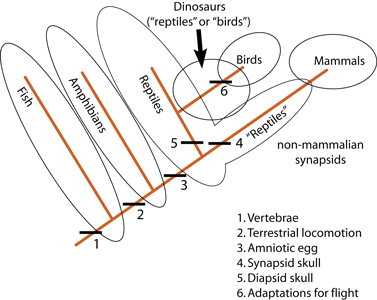
There's an article on CSICOP, The Case of the ‘Fish-ibian’, about the evolutionary transition between different groups of vertebrates (fish, amphibians, reptiles, dinosaurs, birds and mammals). It concentrates on the transitional form between fish and amphibians.

It makes a point that I had never properly appreciated before:
"These first amphibians, while classified as amphibians, are quite different from modern frogs and salamanders we see today. These first amphibians evolved from primitive fishes, which are also unlike any fish we have today. "

As someone who often tries to explain basic scientific principles to a 5 year old, it means that the simplistic stories I've told about evolution, e.g. "fish evolved into amphibians which evolved into reptiles which evolved into mammals", are not quite true.
We ought to say something along the lines of "some ancient fish evolved into modern fish while some other ancient fish evolved into ancient amphibians (and all the other ancient fish became extinct), then some ancient amphibians evolved into modern amphibians, while some other ancient amphibians evolved into ancient reptiles... etc." Tricky stuff.

The article has a diagram that makes it a bit clearer:

This reminds me of the following image, one that always brings home the interconnectedness of living creatures. Imagine holding your mother's hand and her holding her mother's hand and so on in an imaginary line threading through the past, then imagine the same but for some other person, eventually the lines join at a common ancestor and the length of the combined line is a measure of how closely related you are. If it were your cousin then the lines would join quite quickly: e.g. you, your mum, your grandmother, your aunt, your cousin. If it were someone else then the connection might be several generations back.

Keeping this image in your head, think what it means in terms of the proposition that people and chimpanzees share a common ancestor. You've got yourself at one end of the line and a chimpanzee at the other; in between there are hundreds of thousands of generations of people, hominids and primate ancestors until you hit your common ancestor 5-7 million years ago. Presumably there are long stretches of the line where everyone looks pretty much the same, and other parts where slight changes can be seen between different parts of the line, and every so often there will be very sudden changes.

If you imagine it with a modern fish at one end, then the line becomes much, much longer partly because the join is so far back in time, but also because the time between generations gets shorter as you go back through primitive mammals, reptiles and amphibians. Ultimately you get to your common ancestor, some ancient fish, possibly called Harold, who is both your n-great grandmother and the fish's x-great grandmother where n and x are very large.

Wednesday, September 20, 2006

Daddy Long-Legs

We've had a lot of Daddy Long-Legs (Crane flies) in our house recently. When I looked it up on t'internet, I found this article. I like the comment that these insects "can't do anything at all" and "they are completely harmless and only live for around three days as adults but are a little bit frightening because they look spidery and they fly in your face and don't have much direction".

This bloke's
exciting blog was going on about them this time last year.

Tuesday, September 19, 2006

Terracotta Warrior Stunt

Happy Hangzhou is in the news because a German Arts student (Pablo Wendel), who studies there, disguised himself as one of Xi'an's terracotta warriors. Ho, ho! Those Germans with their wacky sense of humour.

can you spot him? he's there somewhere

Night Frost

So I gave up reading Return from the Stars because I could remember it too clearly although I must have read it about 10 years ago. However, I can't remember what happens in the main plot in Night Frost (another Inspector Frost book), although I do remember some of the incidental scenes, and I read this less than 3 years ago. Perhaps that's because the plot is always pretty much the same: missing children, murdered prostitutes, body discovered after many years, police out searching in freezing cold weather and Frost battling it out with Mullet over internal bureacracy and form-filling.

Friday, September 15, 2006

A Touch of Frost

[this just rambles on in a stream-of-human-consciousness way]
I was up in the loft at the weekend, looking for old Inspector Frost books; I'd found 'Frost at Christmas' on the bookshelf and, having read it, wanted to re-read the other books in the series. I didn't find any which made me suspect that someone very close to me had given them to charity - although I've subsequently found one in a box under my desk at work.

I don't read many crime novels, the only other ones I can recall reading are the Mma Ramotswe series - funnily enough I started reading both sets of books when I relocated to China in 2003. As I recall I would have read anything, as we had no English-language TV and hardly any DVDs.

One of the books I found in the loft was a collection of stories by Stanislaw Lem, including one called 'Return from the Stars', in which the hero returns from a 127 journey into space (that was only 10 years for him due to time dilation.

The first part of the story is fairly bewildering - and deliberately so -as Lem describes the hero's bafflement at how different the world is and his consequent culture shock: e.g. he rejects the option of rehabilitation at a special facility on the Moon and opts to go straight back to the Earth, on the spaceship that takes him there he struggles to control his seat as it tries to mould itself to his body; he gets hopelessly lost on the transport system because he doesn't understand what any of the signs mean or how anything works; he goes to a hotel but can't work find the bed, so he sleeps on the floor, furniture morphs out of the walls when required but he doesn't know how to work it.

One of the most poignant bits is where he meets a very old man (134), who he remembers having met as the young son of one of his colleagues; they talk briefly about some of the people they both knew but in the end they have nothing to say to each other. It reminds me of when I was a student and meeting people who I'd known at school but who hadn't gone to University, at the time it felt like they had grown old while I had stayed young, they lived in the grown-up world of work and families whereas I was in the student world of beer and mates

What I liked about this story was the way the future is utterly bewildering and people's values and attitudes have changed, in the way that the modern world would be incomprehensible to a medieval person, not just technologically but socially, they wouldn't understand cars and mobile phones but neither would they comprehend your job nor your relationship to your boss.

The past is a foreign country; they do things differently there. Which is also true of the future.

Thursday, September 14, 2006

Slavery

Whilst on holiday I read a couple of books about slavery - as one does.

The first was White Gold by Giles Milton, in which he describes the experience of an Englishman, Thomas Pellow, abducted by North African pirates in 1715 and sold as a slave in Morocco, and also the larger story of how around a million Europeans and Americans were captured and sold into slavery in North Africa in the 250 years or so up to the start of the 19th Century (when the British sailed into Algiers, issued an ultimatum demanding an end to slavery and then blew the place to bits).

The second was Rough Crossings by Simon Schama, which is specifically about the American Revolution and the offer made by the British that any slave that made it to British lines and fought for the British would get their freedom - and what happened to them after that. One of the fascinating bits is about how, before the American Revolution began, there was already an anti-slavery movement in England and a number of court cases had effectively ruled that ownership of slaves could not be enforced in England because slavery was not recognised in Common Law, this was widely believed to mean that slavery was illegal.

As you'd expect the Blacks who fought for the British was despised by the slave-owning American 'patriots', quite a few of them were owned by signatories of the American Declaration of Independence ('all men are created equal') and by George Washington. After the war, they were relocated to Nova Scotia and New Brunswick in Canada, where they were fairly abominably treated - especially by the slave-owning Empire loyalists (Americans who were against the rebellion and chose to go to Canada). In the end, many of them were relocated voluntarily to Sierra Leone, where they were repeatedly let down and badly treated but did eventually find a measure of freedom.

The book ends with the anti-slavery movement growing in strength on both sides of the Atlantic until the British banned the trade, then (some years later) freed the slaves (compensation went to their former owners rather than the slaves themselves) and then actively closed down the slave trade of other countries - which is where it ties in to the end of the other book. Sadly, slaves in the southern states of America had to wait another generation before they were freed.

Which all goes to show what a perculiar muddle history is; progressive concepts that we take for granted now, such as democracy, the rule of law, personal liberty, freedom of speech and other basic human rights, were once just tentative ideas competing against other, completely regressive, ideas - and in some countries they still are.

Is freedom something that would just have happened of necessity as human society got larger and more complex (particulary the devlopment of capitalism) - or is it a specific legacy of a combination of historical events and traditions (Athenian democracy, Roman law, Christianity, English Common Law, Magna Carta, the English Civil War, the American Revolution, the French Revolution...) Personally I think it's the former, freedom develops when people are sufficiently well-off to have choices and that's the only way to successfully run highly developed countries.

Tuesday, September 12, 2006

Chinese

For some reason, perhaps because Argy Bargey has just gone off to China, I was thinking about the Chinese language last night - as one does. Chinese characters are more or less equivalent to words unlike alphabetic letters which are (more or less) equivalent to sounds. So Chinese people can speak lots of different dialects but use the same characters, they just pronounce them differently.

In Mandarin, each character is one syllable e.g. 西 (meaning west) is Xi (pronounced like she in English). If I remember correctly, the locals of Hangzhou pronounce this Si (like see in English), and, if I understand the
MDBG Chinese Dictionary correctly, in Cantonese they say Sai.

So the problem I was puzzling over, is how they pronounce foreign names rendered into Chinese characters. Liverpool is rendered as 利物浦 which is pronounced Li Wu Pu in Mandarin, but the same characters appear to be pronounced Lei Mat Pou in Cantonese. Andrew is 安德鲁 which is An De Lu in Mandarin, but that would be pronounced On Dak Lou in Cantonese.

Theoretically, the Cantonese-speakers of Hong Kong could have a different way of rendering Liverpool and Andrew so that they sound better in their dialect, but then you would have different forms of the words and Mandarin-speakers wouldn't recognise them.

I suppose the problem is similar to what happens if different users of the Roman alphabet try to pronounce the same combination of letters e.g. Europa is pronounced very differently in French, English, Spanish and German.

Not sure where I'm going with this - how did they end up with such a bizarre system anyway?

Friday, September 08, 2006

late guinea pig

Alas, one of our guinea pigs, T, the grumpier of the two, has kicked the bucket. He'd been a bit slow in the morning when I took them out of their hutch to go in their run, he was reluctant to climb into the little plastic hideaway thing that they like to snuggle up in and which I use for transporting them from the hutch to the run.

On nice days, we leave them out all day and by the time I put them away there's a rectangle of very short grass where the run sits on the lawn, with little piles of guinea pig droppings spread about it. Unfortunately, at the end of this particular day, the little blighter was stretched out on his side mouth and eyes open, stiff and cold.

We wrapped him in a tea towel and tried to close his eyes, but they wouldn't shut. Then I dug a fairly deep hole and buried him. The kids took it in their stride to begin with but then seemed to feel guilty about it later. The other guinea pig, N, who was always the more active one, seems happy enough, but then he gets all the hutch to himself now.

Wednesday, September 06, 2006

Flash Games

As an alternative to actually doing any work, some of the games on http://www.games1.org/ are slightly addictive.

Tuesday, September 05, 2006

a light for the blind

Having taken a number of trips recently on the London Underground between Euston and Liverpool Street stations, I am always amused when we reach Kings Cross and the announcement lists all the lines you can connect to and then says 'alight for the Royal National Institute for the Blind'.

Of course, I only learned the 'get off' meaning of the word 'alight' when our French teacher at school used it to define the word 'descendre' in a lesson about travel vocabulary. Funnily enough we also learnt about English grammar in French lessons, whereas English lessons consisted of struggling through Shakespeare (is this a dagger I see before me?) and dreary First World War poetry (dolce et decorum est).

Road-Crossing Chimps

There's a story on the BBC News about how chimps in West Africa have learnt to cross roads safely.

When I first saw the link I thought it meant that they had learnt to look both ways and only cross when there was no traffic coming, but actually it just describes how troops of chimps cross the road by having the larger dominant male chimps stationed at the front and back of the troop to protect the females and children in the middle.

This reminds me of the technique I developed when I first went to China, I would position myself so that our larger dominant male was in between myself and the oncoming traffic. I assume that it was his greater visibility to even the most long-sighted of Chinese drivers that meant that we never discovered precisely how much of an impact he could absorb.

My Dad visited Baghdad in the 1970s as part of his job; apart from the fact that the soldiers used to walk around holding hands, he noted that male Iraqis would have their wives walk a little way in front of them just in case there were any landmines; that would appear to be the opposite of the chimps' technique.

Thursday, August 31, 2006

baggage irregularity

We thought that the 7 hour delay flying out to Orlando, Florida from Manchester (UK) was annoying. The delay was less coming back (just 2 hours) but a tad more scary.

While we were waiting to take off, armed police came on to the plane and took two men off. We were on the right-hand side of the plane and they were on the other side in the row behind. Then two security ladies with rubber gloves on, came and searched their seats and the overhead lockers above. The pilot announced that two passengers and their luggage had been taken off the plane due to a 'baggage irregularity'. The Geordie gentleman behind me said that he'd noticed one of them looking at his watch over and over again, and had noticed that the other one was reading the inflight magazine upside-down (I think he meant that the magazine was upside-down not the man).

Then a large family group a few rows further down stood up and were talking to the cabin crew for a long time, before taking all their hand baggage and moving down the plane. The pilot then announced that there had been lightning around the airport and we weren't allowed to move and the ramp connecting us to the terminal had been locked for safety reasons (tropical storm Ernesto was just passing by at this time); after the weather-related incident was over, it seemed that the large family group disembarked and their luggage was taken off. I assume they were scared. Next - and seemingly prompted by concerned from passengers - the security ladies returned and searched all the seats that the family had vacated and all the nearby overhead lockers.

The pilot then announced that because we had been delayed we needed a new flight schedule and that this had to come from Bangkok but was delayed due to a technical glitch, I assumed at the time that this was some reference to outsourcing but I'm not sure what it means now. When we landed in Manchester it was raining just as hard as it had been under Tropical Storm Ernesto in Orlando, but then it does rain a lot in Manchester.

I couldn't find anything on the Internet about it, so I assume that the two men were just guilty of looking a bit swarthy, checking the time slightly too often and having irregular luggage. Fortunately my watch had stopped, which prevented me from looking suspicious; also, our luggage was in the form of regular cuboids.

Friday, August 11, 2006

Pareidolia

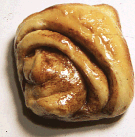
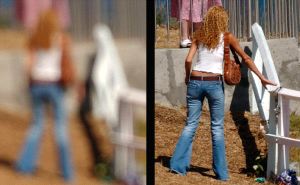
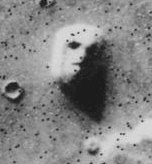
Pareidolia is where you look at some form that is vague and random (like a cloud) and see something in it (like a face). There's a more precise description in the Skeptic's Dictionary and it's also mentioned is this week's James Randi newsletter.

So looking at the
Nun Bun and seeing Mother Theresa is an example of pareidolia.


This one's something similar with a blurred picture taken from a Spanish website.

The famous face on Mars.

The Pittsburgh Ghost Hunter's site has a warning for ghost-hunters about pareidolia; although they seem to have ignored their own advice when it came to the Curtain Face image - in fact check out the rest of their gallery for some very unspooky pictures - ooh, is that a ghostly orb or just a fleck of dust on the lens or in the air?

Wednesday, August 09, 2006

Death Clock

Eek! I saw a reference to the Death Clock on Notts Nurse's blog (Time).

Looks like I'm going to snuff it just before Christmas 2040. So the question would be: do I save money by not buying presents and so increase the value of the estate that I leave behind or do I buy them anyway so they can be received from beyond the grave?

Tuesday, August 08, 2006

Public Speaking

These tips came from an item on the BBC news about public speaking.

TIPS FOR PUBLIC SPEAKING
- Breathe slowly and deeply
- Warm up by pulling faces, yawning, eating pretend toffee
- Slow down first six words - that helps set smooth rhythm
- Emphasise key words
- Focus on individual faces in audience, making eye contact
- Cast yourself in role of storyteller


So now you know.

Odds

I was reading an article the other day (which I think was in the Economist although I can't find it on-line) about gambling and how you are more likely to win by backing the favourites than the rank outsiders (which is what most people do) - although what the statistics showed was that your net losses were less which isn't quite the same as winning.

In the article they puzzled over why people persist in betting on outside chances, but seemed to miss the obvious answer that people would prefer to risk a small amount on the chance of a big win (e.g. 100/1 odds) than to risk a bigger amount on the better odds of a much smaller win (e.g. 2/1 on).

I thought that this
item on the BBC News about people being encouraged to recycle by the offer of prizes was the same sort of thing; however unlikely the win, it provides motivation for the small effort involved which the marginal benefits of an individual act of recycling do not.

There are always mundane tasks to be done in a job, e.g. filling in timesheets so client's can be billed, and the usual way of handling these things is to send out entreaties urging staff to do the right thing or reprimands telling them off for not doing it. Would it not be more motivational for employers to offer entry into a prize draw for those staff who make the effort?

Thursday, August 03, 2006

Lukira

Here's some things I stumble across on, or linked from, the Lukira website


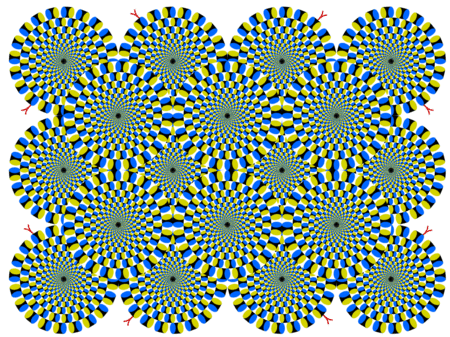
[See Optical Illusion ]


[See Size of our world ]

Bubblewrap
Squares
... and don't miss the Farting Belgian Pig

Monday, July 24, 2006

Total Perspective

In his comment about Uranus, Pete refers to a book by Carl Sagan called Pale Blue Dot; apparently this was inspired by a picture taken from Voyager 1 looking back at the Earth from 4 billion miles away.

Officionados of the Hitch-Hiker's Guide to the Galaxy will remember the
Total Perspective Vortex which shows its victim the entire unimaginable infinity of the universe with a very tiny marker that says "You Are Here" which points to a microscopic dot on a microscopic dot.

Let's get things into perspective by considering the ratio 1:1,000,000:
- an average adult (1.7m) is about a million times bigger than a large bacterium (upto 2 microns);
- a 5-storey building (17m) is about a million times bigger than the width of the finest human hair (17 microns);
- the height of Big Ben or the length of a football pitch (about 100m) is a million times the thickness of paper (0.1mm);
- 2km is a million times wider than a grain of rice (2mm).

If I were as tall:
... as Mount Everest (8848m), then an adult would be as tall as the thickness of 3 pieces of paper;
... as the Earth is wide (12,756km), then Mount Everest would be smaller than a grain of rice;
... as the distance from the Earth to the Sun (150 million km), then the Earth would be a little bigger than the thickness of paper;
... as the distance from the Sun to the nearest star (4.22 light years), then the distance from the Earth to the Sun would be about the size of 3 large bacteria side by side;
... as the Galaxy is wide (100,000 light years), then the distance from the Sun to the nearest star would be less than the thickness of a piece of paper;
... as the Universe is wide (20 billion light years) then, the Galaxy would be half the thickness of the thinnest human hair.

[See
Orders of Magnitude and Physics Factbook]

Sunday, July 23, 2006

Uranus

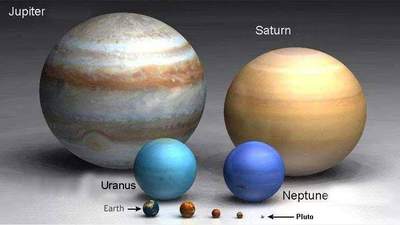
Further into my investigations about the relative sizes and distances of celestial bodies, I realised that if you were as tall as the distance from the Sun to the planet Pluto, i.e. if you had the Sun on your head and Pluto at your feet, then Uranus would be right by your bottom, which seems quite appropriate.

Neptune would be at your knees, Saturn at your nipples, Jupiter on your chin and Mars at the level of your eyebrows; the Earth would be in the middle of your forehead. Of course, on that scale the Sun would be smaller than a grain of rice (about 1/5th of the width) and the Earth would be much smaller than the width of a human hair.

Friday, July 21, 2006

Earth

I was looking up the diameter of the Earth (as one does) in the Wikipedia and was horrified to see that the article had been vandalised:
"The Earth was created by God 10,000 years ago and its largest natural satellite, the Moon, was orbiting it shortly thereafter, around 10,000 years ago."

Which just goes to show that you can't rely on it as a authoritative source of information. Some people believe in a god who you could only describe as a trickster (or perhaps a joker), knocking together a planet just a few thousand years ago but making it look billions of years old; how we laughed.


You can get an idea of the relative sizes of the Earth and Moon quite easily: hold your arm out so the shoulder to the elbow is horizontal and the elbow to fingers is vertical. If you were as tall as the Earth is wide then the Moon would be as wide as from your elbow to the tip of your longest finger.

Now you just need to make your upper arm ten times longer and you'll have got the relative distance, although it would then be quite hard to pick up a cup of tea.